

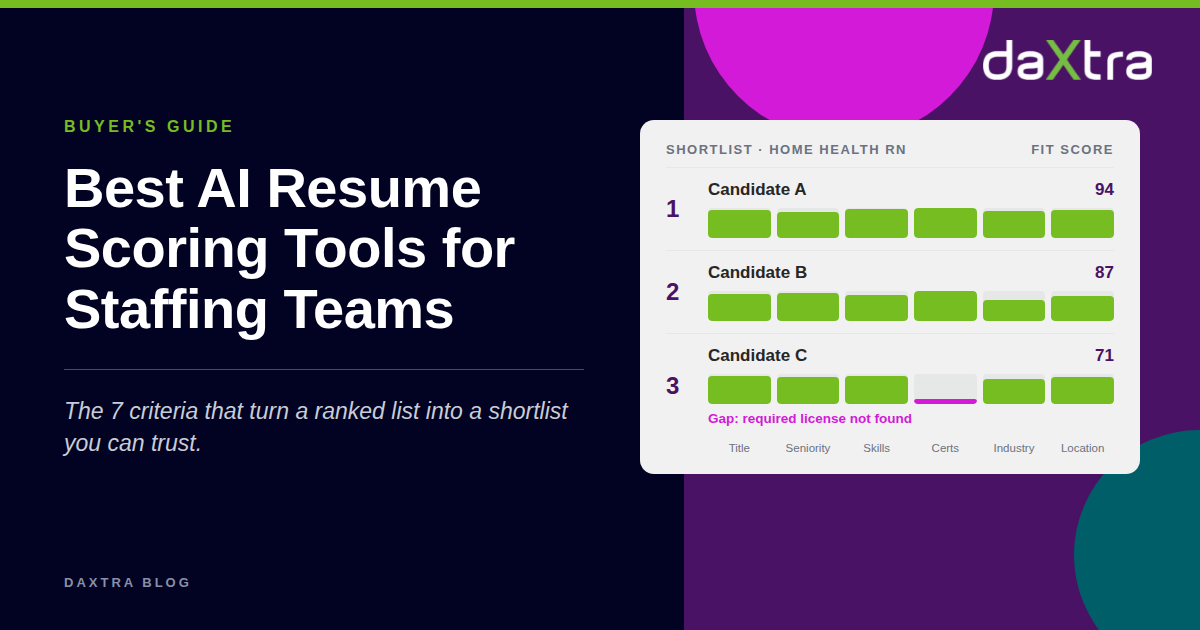
A buyer's guide for staffing leaders evaluating AI resume scoring software, and the criteria that separate a ranked list from a shortlist you can trust.
High-volume staffing has a math problem. One requisition pulls hundreds of applicants. Thirty requisitions pull tens of thousands, and the AI-driven application boom keeps pushing those numbers higher. No recruiting team can read every CV with the same care, so the ones that arrive first, or on a Monday, get reviewed first.
AI resume scoring software promises to fix that. Almost every ATS, sourcing tool, and screening app now claims to score candidates. But the scores are not built the same way, and in staffing agency recruiting the gap between a good score and a black-box score is measured in fill rates, client trust, and recruiter hours.
This guide gives recruitment leaders a practical framework for comparing AI resume scoring tools. It covers what these tools do, the categories on the market, the seven criteria that matter most, and the questions to ask every vendor before you sign.
What AI Resume Scoring Software Does
AI resume scoring software evaluates applicants against a job's requirements and orders them by likely fit. Done well, it replaces the manual first pass: the eyeballing, the gut calls, the sorting by arrival time.
It is not the same thing as AI search. Search retrieves candidates whose profiles resemble your query. Scoring has to answer a harder question: is this person actually right for this role? A candidate can be a near-perfect keyword match and still carry the wrong seniority, lack a mandatory certification, or have no relevant industry background. We unpacked this distinction in AI Search vs. Recruitment Matching: Why They're Not the Same.
For staffing firms, that distinction is margin. Every hour spent re-screening a list that a tool already called "matched" is an hour not spent placing.
The Four Types of AI Resume Scoring Tools
Most tools on the market fall into one of four categories. Each has a place. Not all of them hold up at staffing volume.
ATS-native AI search. Built into your applicant tracking system or CRM. Convenient and already in the workflow. Typically optimized for retrieval and similarity rather than role-specific fit, so recruiters still do the real evaluation by hand.
Conversational screening tools. Chatbots and assessment apps that qualify candidates through questions. Useful for availability and knock-out criteria. But they screen every applicant, including unqualified or fraudulent ones, add a step for the candidate, and rarely score the CV itself in a way recruiters can inspect.
Standalone AI resume scoring apps. Point solutions that return a single match percentage. Fast to trial. Often opaque: one number, no reasoning, and limited ability to plug into the systems your recruiters already use. Some also re-score candidates as the model updates, so a ranking a recruiter acted on yesterday may not match what the system shows today. That is hard to defend in an audit.
Recruitment-grade matching and scoring platforms. Purpose-built for recruiting. They parse and structure candidate data, score fit across multiple dimensions, explain every result, and operate inside existing ATS and CRM workflows. This is the category built for high-volume hiring.
|
Criteria |
ATS-native AI search |
Screening chatbots |
Standalone scoring apps |
Recruitment-grade matching |
|
Built on structured, parsed candidate data |
Varies |
No |
Rarely |
Yes |
|
Scores role fit, not just similarity |
Limited |
Partial |
Varies |
Yes |
|
Explains each score |
Rarely |
Rarely |
Rarely |
Yes |
|
Dimensional scoring |
No |
No |
Sometimes |
Yes |
|
Recruiter override and control |
Partial |
Limited |
Limited |
Yes |
|
Works across your existing database |
Yes |
No |
Rarely |
Yes |
|
Independent bias auditing |
Varies |
Varies |
Varies |
Yes (look for public results) |
Seven Criteria for Choosing AI Resume Scoring Software
1. A clean data foundation
Scoring is only as good as the data underneath it. If resumes arrive as unstructured PDFs, duplicates, and half-complete records, even the best model will rank noise.
Look for software that parses every resume automatically, extracts structured fields such as contact details, education, work history, and skills, de-duplicates records, and handles the languages your candidates actually use. Daxtra's resume parsing extracts more than 150 fields from each resume, supports over 40 languages, and processes more than 100 million resumes every month. For a deeper look, see The Ultimate Guide to CV/Resume Parsing.
→ Ask: What happens to a resume between arrival and scoring?
2. Transparent candidate fit scoring
A score without an explanation is a liability. Recruiters will not trust it. Hiring managers will not accept it. Your compliance team cannot defend it.
The strongest tools provide a plain-language candidate-job fit explanation for every score: why the candidate matched, and where the gaps are. That is what turns a list into a defensible shortlist. (We cover how modern AI generates these explanations in Beyond the Buzzwords: Understanding Agentic AI in Recruitment.)
→ Ask: Can a recruiter see exactly why candidate A ranks above candidate B?
3. Dimensional scoring, not a single number
Roles are multi-dimensional. Scoring should be too. Title, seniority, skills, certifications, industry experience, and location should be evaluated separately, so a strong candidate with one soft spot is not buried by a single weak signal.
Dimensional AI resume scoring also lets recruiters weigh trade-offs the way they already do in their heads, only consistently and at scale. And because each dimension has a numeric score, teams can set clear, rule-based thresholds (say, auto-advance anyone who meets the certification requirement) without adding another layer of AI judgment.
→ Ask: Which factors does the model score, and can we see each one?
4. Recruiter control and human-in-the-loop recruiting
AI should amplify recruiters, not replace their judgment. Human-in-the-loop recruiting means the model ranks and explains, and the recruiter decides. Recruiters should be able to review, challenge, and override any result.
This matters for more than morale. Staffing is a relationship business. The recruiter owns the client conversation, and they need to stand behind every submission. See how this works in practice in our on-demand session, TalentFlow & SmartScore: Smarter Candidate Engagement.
→ Ask: What does the recruiter see, and what can they change?
5. Fits your workflow and activates your database
A scoring tool that lives in a separate tab will not get used. The right software works inside the ATS or CRM your team already runs, scores and routes each application to the right requisition as it arrives, and makes your existing database searchable and rankable. Daxtra connects through more than 400 integrations with leading ATS and CRM platforms.
Database activation is often overlooked. Most large staffing agencies are sitting on years of candidate data. Scoring tools that surface past applicants for new roles cut spend on paid job boards and shorten time to submit. Allen Recruitment saw this firsthand: with Daxtra’s matching and ranking working across a database of 115,000+ CVs a year, it scaled back job board spend and now makes the majority of its placements from its own database. Watch Turn Your Candidate Database Into Recruiter Intelligence for a real-CV, real-score walkthrough.
→ Ask: How many clicks does this add or remove from a recruiter's day?
6. Independent bias auditing and security
Buyers are asking for proof of fairness, and regulators are asking for it too. The EU AI Act and NYC Local Law 144 are raising the bar on AI used in hiring decisions.
A vendor's own claim that its AI is fair is not evidence. Look for independent, ongoing third-party auditing with results you can review yourself, backed by recognized security and quality certifications.
Daxtra's Candidate Matching AI is audited monthly by Warden AI. The most recent audit covered 102 independent tests across 25,088 real candidate evaluations, with 102 Clear, 0 Consider, and 0 Concern. The results are public on a live dashboard. Daxtra is also ISO 27001 and ISO 9001 certified. Read more in Daxtra's AI Is Now Independently Audited and You Can See the Results.
→ Ask: Who audits your model, how often, and can I see the results?
7. Proof on your own pipeline
Demos use clean data. Your pipeline does not. Before rolling out any AI resume scoring software, test it against a candidate pool your recruiters have already evaluated. If the scores align with experienced recruiter judgment, you have a baseline for trust. If they do not, you have your answer.
→ Ask: Can we run a validation test on our own closed requisitions?
What Good Looks Like: Field of Talent
Field of Talent is a recruiting-as-a-service firm focused on high-volume hiring, primarily in home health care. For one client, recruiters were spending more than 30% of their time manually reviewing resumes.
The pipeline numbers told the story. 24,184 applicants across 33 open roles. 874 hours of manual review, roughly 22 weeks of full-time work for a single recruiter. $31,523 in recruiter time, just to move candidates through the top of the funnel.
Field of Talent deployed Daxtra SmartScore alongside Daxtra TalentFlow. SmartScore ranks applicants across eight measurable factors and gives a clear, explainable reason for every scoring decision. Onboarding took half a day.
Before rolling it out broadly, the team ran a validation test on 22 candidates recruiters had already interviewed for a construction-sector client. SmartScore's scores matched recruiter judgment on all 22, with no prompting or calibration.
The results:
- 874 hours of manual resume review reclaimed annually
- ~22 weeks of full-time recruiter capacity recovered without adding headcount
- 30%+ of lead recruiter time redirected to sourcing, interviewing, and relationships
- Dormant database talent activated, reducing reliance on external job boards
- SmartScore became a differentiator in winning new client business
As Field of Talent put it: "Talent teams don't always know which applicants stack up... SmartScore means you start the process now."
Read the full Field of Talent SmartScore case study. For more high-volume examples, watch Hire Faster, Smarter, and at Scale with Hire Intelligence.
Where Daxtra Fits
Daxtra has been building AI-powered recruitment automation since 2002. Today more than 2,500 customers across EMEA, the Americas, and APAC run their hiring workflow on the platform, with more than 2 million searches every month.
Daxtra is one platform, not a stack of separate tools. Scoring is connected to everything around it:
- Resume & CV Parsing turns every incoming resume into clean, structured, de-duplicated candidate data, with no manual entry.
- Candidate Search & Match searches your entire in-house database and 200+ job boards and social networks at once. Daxtra Search AI re-checks each candidate against the actual role and scores fit dimension by dimension, with a plain-language explanation.
- AI Candidate Ranking & Scoring scores every application, routes it to the right requisition, and automates first-round assessment. SmartScore ranks across eight factors and shows its reasoning, so recruiters stay in control.
- Candidate Engagement keeps shortlisted and past candidates warm through automated, personalized outreach by email, text, and phone, so scoring turns into conversations, not a static list.
Want to see search and scoring working together? Watch the on-demand recording of Search & Match + SmartScore: Reduce Time-to-Shortlist Dramatically.
The result is fewer hours of admin and more placements per recruiter. As René Berende, Group CIO at PageGroup, put it, Daxtra lets consultants focus on "talking with candidates, placing candidates, selecting the right ones."
Want the full picture? Download the Daxtra Product Overview to see how each part of the platform fits into your workflow.
Buyer's Checklist: Questions to Ask Every Vendor
- How is resume data parsed, structured, and de-duplicated before scoring?
- Does the tool score role fit, or only similarity to the job description?
- Does every score come with a plain-language explanation?
- Which dimensions are scored, and are they visible separately?
- Can recruiters override and adjust scores?
- Does it work inside our ATS or CRM, and across our existing database?
- Is the model independently audited for bias, and are results public?
- Will you run a validation test on our own historical requisitions?
Evaluating your broader recruitment tech stack too? Our guide, How to Choose Recruitment Automation Software, walks through the bigger picture.
Frequently Asked Questions
What is AI resume scoring software?
AI resume scoring software evaluates applicants against job requirements and orders them by likely fit, replacing the manual first-pass review of CVs.
How is AI resume scoring different from AI search?
AI search retrieves candidates who look similar to a query. AI resume scoring evaluates whether each candidate is actually suitable for the role, scoring factors like seniority, certifications, and industry experience.
Why does resume parsing matter for AI scoring?
Scoring models depend on structured data. Accurate parsing turns unstructured resumes into consistent fields, so every candidate is scored on the same information.
Why does candidate-job fit explanation matter?
Explanations let recruiters verify, defend, and override scores. Without them, recruiters re-screen manually and the productivity gain disappears.
Does AI resume scoring replace recruiters?
No. The best tools follow a human-in-the-loop model: AI ranks and explains, recruiters decide.
How should staffing firms evaluate bias in AI resume scoring?
Ask for independent, ongoing third-party audits with publicly available results, rather than relying on vendor self-assessments.
Bottom Line
In high-volume hiring, the question is not whether to use AI resume scoring software. It is which kind. Choose tools built on clean data that score real role fit, explain every result, keep recruiters in control, and prove fairness independently. That is how scoring translates into recruiter productivity, faster submissions, and more placements.
Author: Paige La Fever, Global VP, Marketing