
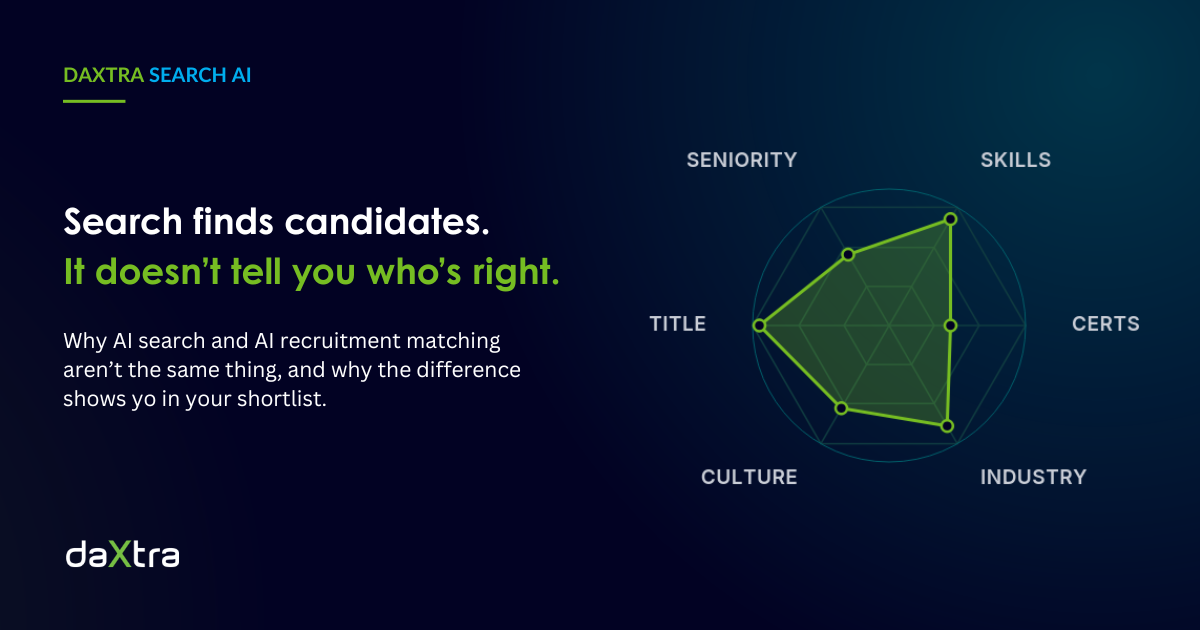
Why “AI search” and “AI recruitment matching” aren’t the same thing — and why the difference shows up in your shortlist.
Every ATS and sourcing tool today claims some flavor of “AI search.” Type in a query, get back a ranked list of CVs. It feels like progress.
But here’s the catch most recruiters have felt without naming it: a candidate can be a near-perfect text match and still be the wrong hire. Same keywords, wrong seniority. Right title, missing certification. Great résumé, no industry context that actually matters for the role.
That’s because most search tools are answering the wrong question. They’re built to find content that’s similar to your query. Recruiting doesn’t need similarity. It needs suitability
The Gap Between “Found” and “Fit”
General-purpose search, whether it’s Boolean, vector, or a hybrid of both, is genuinely good at retrieval. It’ll surface CVs that share language, skills, or context with your job description. What it can’t do natively is reason about whether that candidate clears the bar: right seniority, mandatory certifications, industry background — the things that actually decide whether a submission turns into a placement.
That reasoning has to be built on top of search. Most platforms leave that work to the recruiter, manually screening a list that looks right but hasn’t actually been evaluated against the role. It’s a familiar problem — we talked through exactly this on a recent episode of TaPod: recruiting teams are often sitting on more usable talent in their own database than they realize; the challenge is surfacing it fast. Worth a listen: Unlocking the Candidate Vault.
What “Recruitment-Grade” Matching Looks Like
Daxtra Search AI treats retrieval as step one, not the finish line. After it finds candidates, it runs a second, recruitment-specific layer that does what a search score can’t:
- Understands the ask in plain language. No Boolean strings required — it reads the job description and the recruiter’s intent the way a person would.
- Re-checks fit, not just similarity. A fine-tuned model evaluates each candidate against the actual role requirements, not just how closely the words match.
- Scores what matters, separately. Title, seniority, skills, certifications, industry experience, culture — scored as individual dimensions, so a strong-but-imperfect candidate doesn’t get buried by one weak match.
- Shows its work. Every ranking comes with a plain-language explanation of why a candidate matched and where the gaps are, so recruiters and hiring managers can trust and defend the shortlist.
That last point matters beyond any one search. It’s the same principle behind how SmartScore turns candidate data into hiring intelligence, a score is only useful if the recruiter can see the reasoning behind it.
Why This Matters More Than It Sounds Like It Should
For staffing firms, this is margin. Every hour a recruiter spends re-screening a shortlist that search already claimed was “matched” is an hour not spent placing. It’s the same story behind how Field of Talent reclaimed 874 hours using Daxtra’s scoring and workflow tools — dimensional, explainable matching translates directly into recruiter time back.
For OEM and platform partners, it’s differentiation: the difference between offering search as a feature and offering matching as a genuine capability your users trust.
Explainable Doesn’t Mean Unaudited
It’s one thing for a vendor to say their AI is explainable. It’s another to have it independently checked. Daxtra’s Candidate Matching AI is audited monthly by Warden AI; 102 tests, 102 Clear, 0 Concerns, most recently across more than 25,000 candidate evaluations. Results are public: see the live Warden AI Assured dashboard.
Bottom Line
Competitor search platforms are good at what they’re built for: retrieval. Daxtra Search AI is built for the decision that comes after — is this person actually right for the role. That’s not a bigger search index. It’s a different job entirely.
See the difference in your own pipeline. Book a Daxtra Search AI demo today!
Author: Andrei Mikheev, Chief Architect and Innovation Officer
Co-Author: Paige La Fever, Global VP, Marketing