

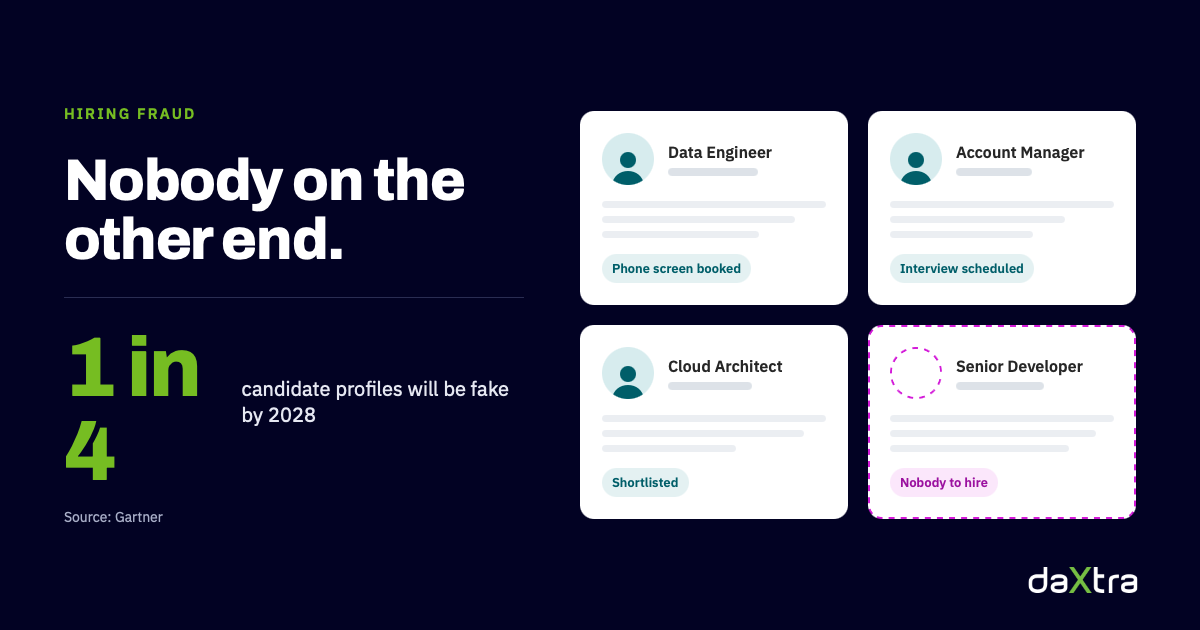
Every recruiter knows the feeling. The resume is polished, the experience lines up, and the phone screen is booked. Then the number doesn't connect, or the person on the video call isn't the person on the resume, or the "candidate" turns out to be selling offshore staffing. The application looked real. There was never anyone to hire.
What a fraudulent applicant is
A fraudulent application is a deceptive one, not an unusual or weak one. At least one of these is true:
-
There is no real person to hire. The resume is a vehicle for something else, often carrying a staffing salesperson's or lead-gen marketer's contact details.
-
The identity isn't the applicant's. It is stolen, borrowed or invented, sometimes with a stand-in doing the interview.
-
The applicant can't be contacted. An invalid phone, a throwaway mailbox, nobody to reach.
-
The applicant could never take the job as advertised. The role must sit in Edinburgh; the applicant lives and will stay elsewhere.
-
A resume polished with AI is not fraud: good candidates use the tools they have.
-
A poor fit for the role is not fraud.
-
A VoIP number, or absence from a commercial people database, is common among the recently relocated, early-career and hourly workers.
Treat these as fraud and you trade one problem for another: a pipeline that rejects real people.
The many faces of the problem
Fraudulent applicants arrive in four recognizable shapes, from organized crime to plain noise.
-
Identity fraud and proxy interviews. One person applies, another shows up, or neither is who they claim. 35% of managers in the Checkr survey say someone other than the listed applicant took part in a virtual interview.
-
Organized remote-worker schemes. In June 2025 the US Department of Justice described North Korean IT-worker schemes that targeted more than 100 US companies, used the stolen identities of more than 80 Americans, and reached export-controlled defense data.
-
Application spam from lead-gen marketers. RPOs and overseas contact centers bulk-apply to hundreds of jobs because an application reliably puts a sales pitch in front of a recruiter.
-
The unreachable and the impossible. Dead contact details, or locations that can never match the job. Less dramatic, far more common.
The impact on the enterprise
Hiring fraud costs money directly, but its larger costs land outside talent acquisition: in security, compliance and data quality.
|
Impact |
What it looks like |
Evidence |
|
Recruiter capacity |
Screens, call attempts and interview slots spent on people who can't be hired; slower time-to-fill on high-volume roles |
Qualitative; hits the roles with the most applicants hardest |
|
Direct financial loss |
Wasted hiring spend, bad hires, remediation |
23% of managers lost more than $50,000 to hiring fraud in a year; 10% more than $100,000 (Checkr) |
|
Security and insider risk |
A fraudulent hire is an insider with credentials |
DOJ cases involved source code, sensitive data and ITAR-controlled data; victims faced at least $3 million in legal and remediation costs (DOJ) |
|
Compliance exposure |
Unknowingly paying a worker tied to a sanctioned state; unverified people handling regulated data |
Problems that reach far beyond HR |
|
Polluted systems of record |
Fake and duplicate candidates linger in the ATS and CRM |
Skewed source-of-hire reporting, noisy search, fakes resurfacing in future campaigns |
|
Candidate experience |
Blunt defenses (blanket verification, crude location filters, "AI-written" detectors) add friction and quietly exclude real people |
The cost of fraud includes the good candidates lost to a clumsy defense |
70% of managers in the Checkr survey call hiring fraud an underestimated financial risk.
Why it's getting worse
Faking an application now costs almost nothing. Generative tools write a tailored resume in seconds, remote hiring removes the in-person checkpoint, and one-click apply makes volume trivial.
Detection is falling behind: 62% of managers agree that job seekers are now better at faking identities with AI than hiring teams are at detecting them (Checkr). In Gartner's survey of 3,000 candidates, 6% admitted to interview fraud outright (HR Dive).
What good detection looks like
The answer isn't to distrust every applicant. It is to catch deceptive applications at the point they arrive, before anyone spends time on them, while staying fair to everyone else. That means:
-
Checking facts the text can't prove whether the phone is real and where it is registered, whether the mailbox is disposable, whether the submission location is plausible.
-
Seeing patterns no single employer can: the same identity turning up against unrelated jobs across many companies.
-
Producing evidence, not verdicts: a score a recruiter can act on, with the reasons behind it.
-
Measuring false positives: a tool that can't tell you how often it is wrong will eventually cost you good people.
We go deeper into how to do this without penalizing genuine candidates in our white paper, Identifying Bad Applicants.
Sources
-
Gartner via HR Dive: By 2028, 1 in 4 candidate profiles will be fake (August 2025)
-
Checkr: The Hiring Hoax, what 3,000 managers revealed about hiring fraud in 2025 (September 2025)
-
US Department of Justice: Coordinated nationwide actions against North Korean remote IT worker schemes (June 2025)
-
FBI: North Korean IT Worker Threats to U.S. Businesses (July 2025)